 Tencent
 Meituan
 ByteDance
MVID: Feed-Forward Multi-View Intrinsic Image Decomposition
SIGGRAPH Asia 2026 · In collaboration with Tencent
Feed-forward decomposition of multi-view images into consistent albedo, shading, and specular residual — no per-scene optimization.
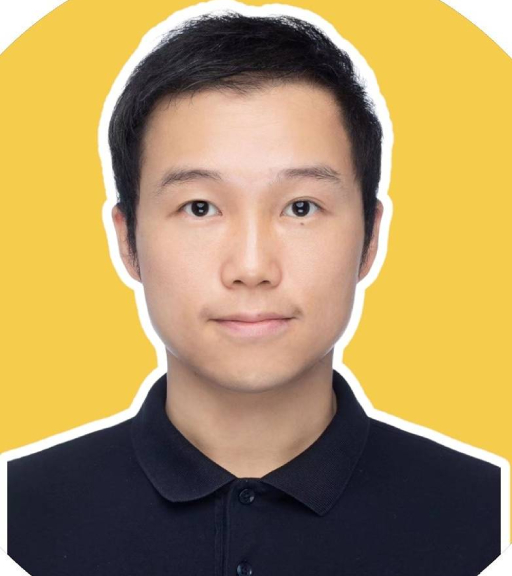
Graphics Researcher & Simulation Systems Builder
PhD candidate, HKUST (Guangzhou)
Experience
I am a PhD candidate at HKUST (Guangzhou), advised by Prof. Zeyu Wang and co-advised by Prof. Ruizhen Hu. My research is on inverse rendering, neural rendering, and 3D Gaussian Splatting, with a focus on light-aware and editable world models — turning real-world captures into scenes that can be decomposed, edited, relit, and re-simulated for robotics and embodied AI.
Before returning to academia, I spent nearly ten years building 3D systems in industry. Most recently I led the simulation platform at LingBot (2025–2026), where I built the data simulation team from the ground up. Earlier I worked on device–cloud collaborative rendering at Tencent (2022–2024), real-time rendering engines at Meituan (2021–2022), and graphics rendering at ByteDance (2020–2021). Before that I founded 云深间造 (2016–2020), a VR startup for virtual property viewing, which received the Technology Innovation Award at the 4th China Home Furnishings Innovation Summit.
I obtained my MBA from the University of Hong Kong in 2024, and my bachelor’s degree from Texas A&M University in 2014.
Research areas: Computer Graphics · Inverse Rendering · Editable World Models · Simulation for Robotics & Embodied AI
SIGGRAPH Asia 2026 · In collaboration with Tencent
Feed-forward decomposition of multi-view images into consistent albedo, shading, and specular residual — no per-scene optimization.
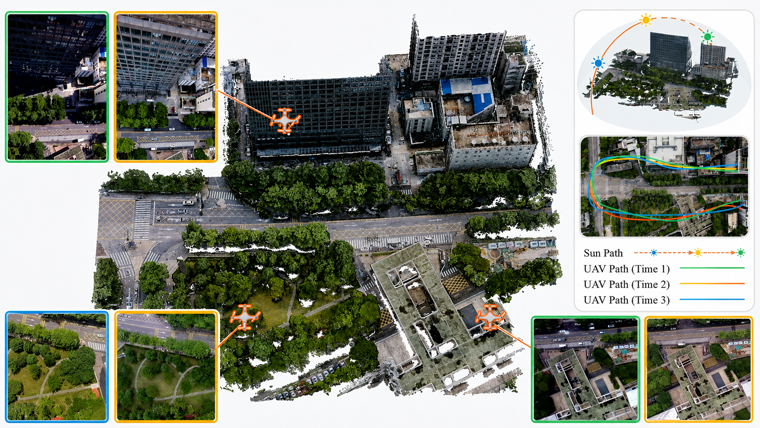
CVPR 2026 · In collaboration with Meituan
A benchmark for illumination-robust reconstruction in real UAV scenes: large-scale outdoor captures across multiple time slots under changing sunlight and shadows.

Shared-template Gaussian instancing that removes object redundancy, enabling compact and efficient rendering of repeated content.
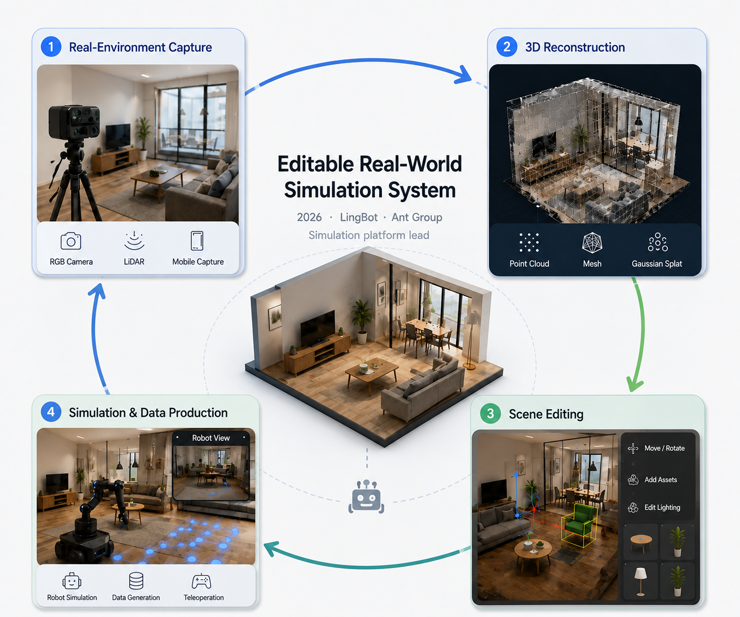
2026 · At LingBot 蚂蚁灵波
Connects real-environment capture, reconstruction, scene editing, and simulation data production for robot data augmentation and teleoperation collection.
ICCV 2025 · In collaboration with Tencent AI Lab
Inverse rendering on 3D Gaussian Splatting: recovers geometry, material, and lighting from multi-view images for material editing and relighting.
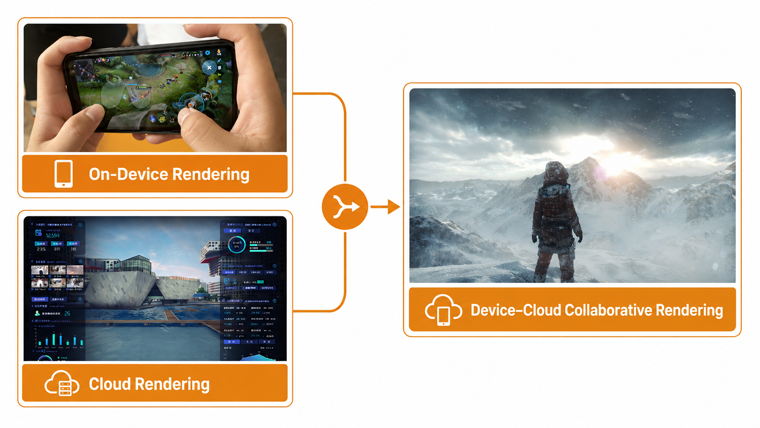
2022–2024 · At Tencent
Splits rendering between device and cloud for cloud rendering and cloud gaming: real-time rendering, low-latency streaming, and compute scheduling in production.
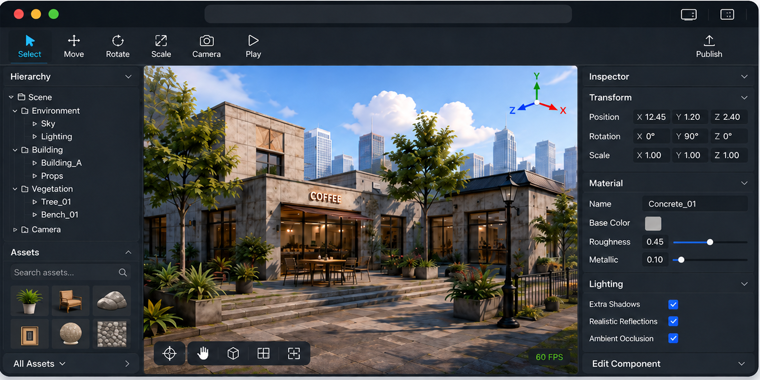
2021–2022 · At Meituan
Browser-based 3D editors letting non-expert teams build, edit, and publish 3D scenes — web real-time rendering, editor architecture, and asset pipelines.
2020–2021 · At ByteDance
A real-time rendering engine for playable ads — interactive HTML5 creatives that run inside the feed. Every scene ships as a self-contained bundle of a few megabytes with no external requests, so the engine had to fit rendering, animation, and interaction into a very tight size and performance budget across a wide range of phones.
2016–2020 · Founder at 云深间造 (startup)
A commercial VR product for virtual property viewing: real-time 3D spaces and interactive walkthroughs — the starting point of my path toward editable world models.
Award: Technology Innovation Award (company) and Innovation Elite Award (founder), 4th China Home Furnishings Innovation Summit, 2019 [coverage]
Feel free to reach out if you are interested in inverse rendering, editable world models, simulation for robotics, or related collaboration.
kdu800@connect.hkust-gz.edu.cn
270382069@qq.com
Email · Google Scholar · GitHub · LinkedIn · CV
 云深间造 (startup)